



New study on psilocybin for smoking cessation
Anyone following the scientific literature on quitting smoking usually sees the same pattern recurring. There are aids that do help, but long-term success often remains limited. That is precisely why this new pilot study into psilocybin for smoking addiction is so interesting. In this study, a single high dose of psilocybin, combined with a structured cognitive behavioral therapy program, worked significantly better than nicotine patches with exactly the same behavioral therapy program. This is important because the comparison was not only made with a placebo, but with an existing and accepted treatment.
Psilocybin worked better than nicotine patches in this study.
The study was conducted at Johns Hopkins Bayview Medical Center in Baltimore and was published in JAMA Network Open on March 10, 2026. It was a pilot randomized clinical trial, a randomized exploratory study. The participants were psychiatrically healthy adult smokers. A total of 82 people participated. The average age was 47.6 years, they smoked an average of 15.7 cigarettes per day, and the median history was six previous quit attempts. The participants were randomized into two groups: 42 people went to the psilocybin group and 40 people to the nicotine patch group.
Both groups received not only a medication but also a complete 13-week, manually developed CBT program for quitting smoking. This strengthens this study, as the effect of psilocybin was not investigated in isolation from guidance, but rather within a therapeutic framework. On the target quit date in week 5, the psilocybin group received a single high dose of 30 mg of psilocybin per 70 kg of body weight. On that same quit date, the nicotine patch group began an FDA-approved nicotine patch schedule of 8 to 10 weeks. For people smoking more than 10 cigarettes per day, treatment started with 21 mg per day for six weeks, followed by 14 mg per day for two weeks, and then 7 mg per day for two weeks. Lighter smokers received a lower schedule.
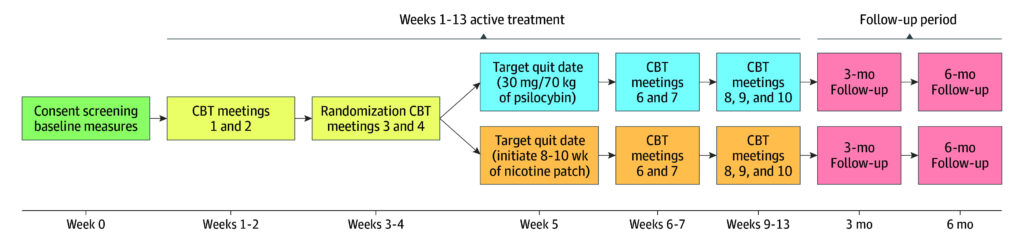
The study looked primarily at biochemically confirmed long-term abstinence after six months. That is important because people were not simply taken at their word. Researchers checked abstinence using, among other things, exhaled carbon monoxide and urinary cotinine, a nicotine breakdown product. For the primary outcome, a two-week grace period after the stop date. After that, continuing to smoke counted as a relapse. Moreover, the analysis was a intention-to-treat analysis, which means that participants who dropped out or were no longer reachable were counted as non-abstinent. This makes the results less inflated and therefore more reliable.
After six months, 40.5 percent of the psilocybin group was biochemically confirmed to be smoke-free for the long term, compared to 10.0 percent in the nicotine patch group. For the second major measure, namely 7-day point prevalence abstinence, this was 52.4 percent versus 25.0 percent. Statistically translated, this meant that the psilocybin group had more than six times higher odds of long-term abstinence than the nicotine patch group, with an odds ratio of 6.12. For 7-day abstinence, the odds ratio was 3.30. The psilocybin group also scored better when looking at daily cigarette use between the quit date and six months later. The model estimated an average of 1.69 cigarettes per day for the psilocybin group versus 3.64 cigarettes per day for the nicotine patch group, thus approximately 53.7 percent less.
The outcome was remarkably strong
You could already see a difference shortly after the stop day. On the day after the target quit date, he reported 90.5 percent of the psilocybin group that they had not smoked for at least 24 hours, as opposed to 80 percent in the nicotine patch group.
That in itself does not say everything about the long term, but it does show that the start of the stopping process in the psilocybin group was powerful.
See also the image.
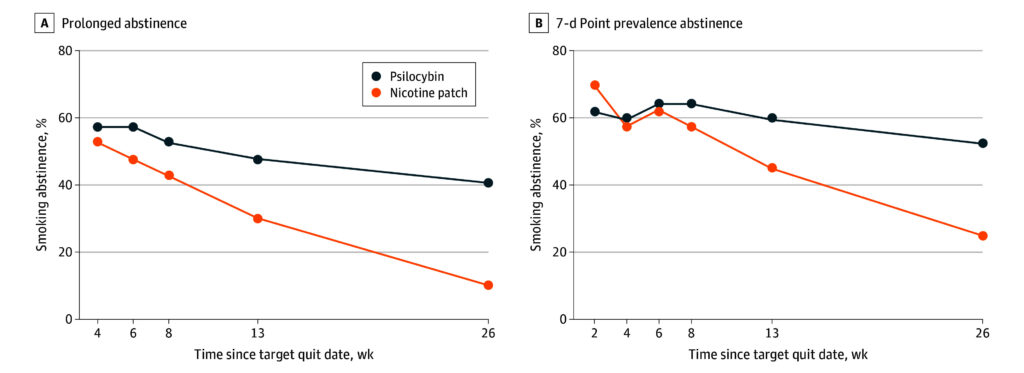
What makes this study particularly interesting is that the nicotine patch group did not perform poorly compared to the literature. In the discussion, the authors refer to a recent meta-analysis in which standalone nicotine replacement therapy yielded approximately 8 percent long-term abstinence and approximately 20 percent 7-day point prevalence abstinence after six months. In this study, the nicotine patch group achieved 10 percent and 25 percent, respectively, indicating that the comparison group was credible. This makes psilocybin's lead more substantial.
Why this study is impressive, but is not yet the last word
This study is strong because it makes a direct comparison with an existing standard treatment, because both groups received CBT, because abstinence was biochemically verified, and because dropouts were not eliminated from the analysis. At the same time, one must be honest about the limitations. It was a pilot study, so it was still relatively small. The study was not blinded, which is practically unavoidable with psychedelics. Moreover, the participants were psychiatrically healthy, predominantly white, and relatively often highly educated, and 64.6 percent had previously used classical psychedelics. That limits generalizability.
There is another important point. The psilocybin group also received more contact time during the trajectory. Over the entire study, participants in the psilocybin group spent a median of 29.6 hours in treatment contacts, compared to 16.8 hours in the nicotine patch group. The authors explain that this difference was primarily due to the 8 to 9-hour psilocybin day and the debriefing the following day. This means that part of the benefit may not stem solely from the substance itself, but from the combination of intensive experience, extra therapeutic attention, and meaning-making. This is actually of particular interest to us as well, because it aligns with the idea that the session is not separate from preparation and integration, but is interwoven with them.
What this study means for the Triptherapie vision
This smoking cessation study aligns remarkably well with how we at Triptherapie have long viewed addiction. In our earlier explanation of psilocybin and smoking addiction, it is explained that psilocybin, after conversion to psilocin, binds to 5HT2 receptors, and that stimulation of 5HT2A receptors is associated with more BDNF, more new connections, and new choices. Additionally, particularly with addictions, we focus on the fact that session preparation is far more important than people often think, because that preparation influences the psyche, neurochemistry, the body, and ultimately the outcome of the session. That is precisely the kind of model to which this JAMA study, although not identical, now lends extra credibility.
The question then becomes not only whether psilocybin works, but also how best to prepare someone for such a change. That is where supporting factors come into play. Not as a replacement for psilocybin, nor with the same level of evidence, but as potential enhancers of calm, resilience, stress regulation, and sustainability.

What else can you do?
At Triptherapie, we believe in the synergy of psychedelics with lifestyle coaching, talk therapy, supplements, and proper preparation and integration. In this article, we are therefore pleased to provide a theoretical foundation for various supplements that can support quitting smoking. This is a selection of the possibilities offered by our holistic protocols.
GABA as an inhibitory counterpart to restlessness and craving
GABA is a neurotransmitter with an inhibitory function on the nervous system. That page states that GABA can promote calmness in cases of overactivity, reduce stress and anxiety responses, and also plays a role in relaxation and falling asleep. This makes GABA relevant for smokers who smoke not only for nicotine, but also to dampen inner tension.
The neurobiology of nicotine also points in this direction. Nicotine influences not only dopamine, but also glutamate and GABA in the mesocorticolimbic circuits. In the VTA, nicotine stimulates both glutamatergic and GABAergic terminals, but due to rapid desensitization of certain nicotinic receptors on GABA neurons, the balance ultimately shifts relatively towards dopamine release. Reviews therefore describe that increased GABA transmission or decreased glutamate transmission can reduce the rewarding effect of nicotine and cue-induced nicotine seeking.
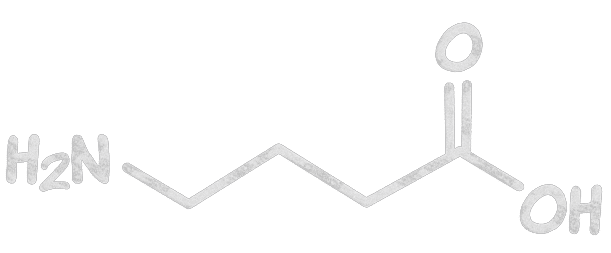
That does not mean that a GABA supplement is a proven smoking cessation treatment in itself. It does mean, however, that the GABA pathway makes sense as a supporting layer. Furthermore, there are ways to improve GABA function, such as diet, supplements, walking in nature, meditation, cuddling, music, and dance. Before you start experimenting with GABA yourself, you should be cautious with benzodiazepines, barbiturates, antidepressants, or alcohol. This can cause problems, so proper advice is important in this regard.
B6 as a possible supplement for more anxiety reduction
Vitamin B6 is of interest because it is involved in the synthesis of GABA. In a double-blind, placebo-controlled study in young adults, participants received either 100 mg of vitamin B6 or a placebo daily for 30 to 35 days. The study included 478 young adults, with 265 participants available for anxiety measurements. B6 reduced self-reported anxiety and increased visual surround suppression, and the authors conclude that their results suggest that high-dose vitamin B6 increases inhibitory GABAergic neural influence.
Source: High‐dose Vitamin B6 supplementation reduces anxiety
This is not direct evidence for smoking addiction, as this was not a smoking cessation study. However, it is relevant in terms of content. Part of smoking behavior is driven by fear or tension. If B6 can slightly strengthen the inhibitory side of the system, then it is biologically plausible that this could reduce the need for nicotine as a sedative. The step from less anxiety Unpleasant less urge to smoke It remains a hypothesis, however, not a proven causal line.
Arginine as a possible enhancer of GABA
Arginine came into the picture via an animal study from 2002. In that study, researchers examined whether rats L-arginine via nitrogen monoxide could increase the permeability of the blood-brain barrier to GABA. GABA alone increased brain GABA, L-arginine alone did so as well, and the combination of GABA plus L-arginine resulted in a much larger increase. When beforehand a NOS inhibitor was administered, that effect largely disappeared. The authors concluded that high NO concentrations after L-arginine can increase the passage of peripheral GABA to the brain.
Source: Nitric oxide production increases gamma-amino butyric acid permeability of blood-brain barrier
That is not direct proof that arginine helps smokers quit, but it is an interesting mechanistic argument for including arginine in a hypothesis regarding inhibition, rest, and tension regulation. Additionally, there is human research in which a combination of L-lysine and L-arginine, both at 2.64 grams per day for a week, reduced both trait anxiety and stress-induced state anxiety in a randomized, double-blind, placebo-controlled study of 108 healthy adults. In men, basal cortisol and chromogranin A also decreased. This did not concern smoking and did not concern arginine alone, but it does support the idea that this pathway may affect stress sensitivity and potentially help with stress-related smoking addictions.
For us, arginine is therefore suitable primarily as potential support in the preliminary phase, not as the primary treatment. Certainly for people who smoke due to nervousness, alertness, or an overstimulated system, this can be of substantive interest, but the level of evidence is clearly lower than for psilocybin.
DHEA as a factor in stress, negative affect, and relapse
DHEA and DHEAS are substances in the body that likely have more to do with how well someone copes with stress, how they feel, and the risk of relapse. Therefore, they are of interest in addiction, even though they are not the definitive explanation for everything.
In smokers, researchers observe that higher DHEAS levels often coincide with fewer feelings of sadness or tension and less nicotine craving. There are also studies showing that the ratio between DHEA and cortisol during smoking cessation may indicate relapse. If that ratio changes unfavorably during the first few days without a cigarette, the likelihood of starting to smoke again in the following week appears to be greater. At the same time, it is not as simple as DHEA alone determining whether someone relapses. It seems rather to be part of a larger whole involving stress, mood, and recovery.
Sources: Neuroactive steroids, negative affect, and nicotine dependence severity in male smokers | Effect of dehydroepiandrosterone add-on therapy on mood, decision making and subsequent relapse of polydrug users
The strongest evidence that DHEA may help comes from research in people with multiple co-occurring addictions. In that study, participants received either 100 mg of DHEA or a placebo every day for a month. The group receiving DHEA felt less negative during the treatment and also re-used addictive substances less frequently in the months that followed. That study did not specifically focus on smoking, but it does show that DHEA may help with smoking addiction, particularly regarding stress, mood, and relapse.
Combine everything with lifestyle changes
At Triptherapie, you therefore also receive support regarding lifestyle. This goes beyond just general tips. It also involves balancing neurochemistry through nutrition, supplements, and practical advice tailored to your situation. Think of supporting neurotransmitters such as GABA, serotonin, dopamine, and acetylcholine, so that the nervous system can become calmer and more stable. It is precisely this more stable foundation that can ensure you are less likely to reach for nicotine during moments of stress, anxiety, or fatigue.
The goal is not to replace smoking with lifestyle changes alone, but to reduce the underlying vulnerabilities. If you sleep better, experience less energy fluctuation, feel more at peace, and can recover emotionally better, it becomes easier to let go of old patterns. Lifestyle coaching thus forms a strong foundation for the entire process. Not only to enter a session better prepared, but also to better sustain the change afterwards.
Conclusion
Psilocybin currently provides the strongest scientific signal regarding smoking addiction. In this comparative study, psilocybin even worked better than nicotine patches. This is remarkable and deserves serious attention. At the same time, this subject also shows that good preparation can make a significant difference. GABA is primarily associated with more calmness and less restlessness. Vitamin B6 may potentially help support that calming GABA effect. Arginine is interesting because it may influence stress and the way GABA works. DHEA appears to be particularly important for sadness, tension, and the risk of relapse. Lifestyle coaching helps to make the body and brain stronger and more stable, so that change is easier to sustain.
The fairest conclusion, therefore, is not that all these components together have already been proven to constitute a single, fixed treatment. What we can say, however, is that these factors together form a logical and strong whole, and that we see significant progress in practice when combining these elements. Individually, the separate components focus on more calm, less stress, better neurochemical balance, and breaking old patterns. Within this framework, psilocybin is currently the component with the strongest directly proven effectiveness, and yet we believe in a better holistic approach. That is precisely why an approach involving preparation, lifestyle, guidance, and integration fits so well with smoking addiction.
Use our protocol
At Triptherapie, we therefore do not work with just a session in isolation, but with a protocol in which multiple components come together. We look at safety, intake, lifestyle, neurochemical balance, intention, guidance during the session, and integration afterward. This makes the approach suitable for people who not only want to stop temporarily, but want to understand why the addiction developed and how they can maintain a new direction.
If you would like to use the Triptherapie protocol yourself for addiction or smoking addiction, you can sign up for an intake so we can determine together which form of guidance suits you best. This allows us to assess whether a program including lifestyle coaching, preparation, and a guided psychedelic session is a suitable step for you.
Reviews about addiction
Anyone wanting to quit smoking or break another addiction often benefits more from relatable real-life stories than from theory alone. That is why you will find nine previous experiences below from people for whom addiction, dependency, or stubborn habit patterns played a significant role. In these stories, you will read how preparation, lifestyle, guidance during the session, and integration can make all the difference together. It is precisely this combination that often ensures an insight does not remain merely a nice moment, but can truly have an impact on daily life.
Turn on the reset button and go 🙂
An experience involving a clear turnaround, increased motivation, and the feeling that a switch has truly been flipped towards a healthier life.
MDMA trip 1 & 2
An experience with two MDMA sessions focusing on deepening, processing, and lasting change.
Truffle ceremony for alcohol addiction
A review focusing on alcohol addiction and describing the session as part of a deeper change.
Review of individual truffle ceremony
An individual session in which personal patterns, lifestyle, and positive change clearly emerge.
Experience with psilocybin therapy at my home
A home session focusing on preparation, safety, and the effects of psilocybin in the days afterward.
An extraordinary experience!
A special experience with guidance from Janneke, with an emphasis on trust, safety, and inner transformation.
1st time truffle session
A first experience with truffles in which curiosity, excitement, and new insights come together.
In search of answers with the help of psychedelics
An experience about introspection, self-exploration, and using psychedelics to find direction and clarity.
Quit smoking after 20 years, 2nd session with Marcel
A review focusing on quitting smoking, living healthier, and a clear behavioral change.