
Classical psychedelics
Classical psychedelics often refer to natural mind-altering substances. What all these substances do to achieve their mind-altering effects is essentially the same, but in a roundabout way: they increase the stimulation of serotonin receptors. Stimulation of the 5-HT2a receptor, in particular, produces the mind-altering effect by altering the conduction of impulses in the brain. In particular, multiple areas of the brain that don't normally communicate directly then begin to communicate. For example, at higher doses, the areas that typically process subconscious tasks may begin to communicate with your conscious brain, the frontal lobe. This can alleviate psychological symptoms.
Endogenous psychedelics
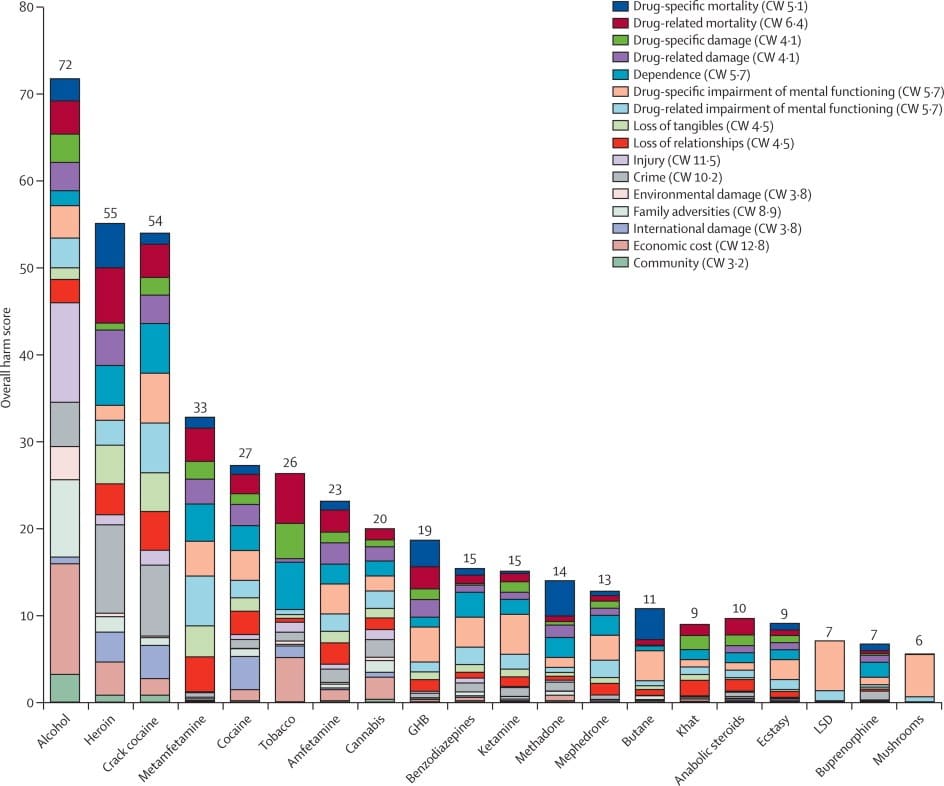
Many people, especially those unfamiliar with psychedelics, consider psychedelics like magic mushrooms worthy of the negative connotation of "drugs." However, they don't realize that alcohol is a much worse drug than magic mushrooms, and therefore often drink a glass of wine too many.
See also the image below or via this link the differences in harmfulness of psilocybin, alcohol and other drugs.
Another argument for not calling psychedelics drugs is that everyone hallucinates every night because the body triggers the same process during sleep that psychedelics do during wakefulness. Dreams are the result of increased activity of the serotonin receptors, particularly the 5-HT2a receptor. Everyone therefore uses the body's own "drugs" during sleep. Even while awake, you can use techniques that mimic the effects of dreams and psychedelics. Meditation, hypnotherapy, breathwork therapy, and EMDR are examples. During these techniques, it feels to the body as if you're going to sleep and dreaming, which triggers the production of psychedelics (DMT and serotonin). However, the advantage of psychedelics is that you can adjust the dosage, reach higher doses (up to 1000 times higher), and that the effects are longer-lasting.
DMT and serotonin
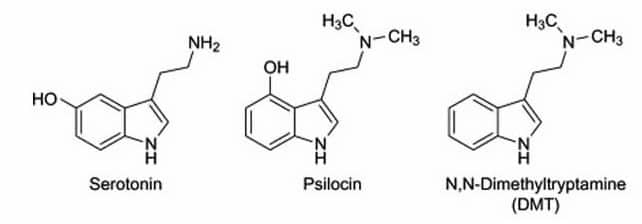
DMT and serotonin are therefore our body's own psychedelics. The mind-altering effects occur when the concentrations of these substances are elevated. Low concentrations, however, cause cognitive decline, depression, anxiety, insomnia, and other psychological complaints. The structure of the DMT and serotonin molecules is similar, allowing them to bind to the same receptors.
Psilocin from mushrooms and truffles
Our body converts psilocybin from magic mushrooms into psilocin. Psilocin, like our own serotonin and DMT, can stimulate the 5-HT receptors. This primarily affects the 5-HT2a receptor and, to a lesser extent, the 5-HT2c and 5-HT1a receptors. This also causes the human brain to enter a kind of "sleep mode." The connection between the subconscious and conscious minds is established, and the higher the dose, the more the connection is established. This can lead to hallucinations and waking dreams. An added benefit is that in a dream state, one has no cravings. There is no need for food, no need to achieve personal goals, and a state of contentment arises.
State of contentment
From a state of contentment, one can often be honest about what's truly important. We can be realistic about perfection and imperfections. Uncertainty and certainty are things you control. Another added benefit is that the subconscious mind, with all its fixed patterns, is open to insights and change. Combined with neurogenesis, which creates new, established brain connections, this allows people to truly change for the better. All of this is possible with the power of something akin to deep sleep.
We need to look beyond the old stigma
Everyone should embrace magic mushrooms and truffles as a gift from nature. So many people have already benefited immensely from mushroom treatments. All research conducted on psilocybin has achieved a success rate higher than anything any pharmaceutical company can imagine. From our own experience, we can tell you that the success rate of research could be even higher if a love for the body is also incorporated into the process.
What we can offer
Do you also want to grow in life? Our services encompass more than just organizing a mushroom ceremony. We always consider our clients' goals. For example, we have protocols that we tailor to the client's needs. We have protocols for various issues, such as:
- Depression
- Burnout
- Fears (social, etc.)
- Addictions (alcohol, cocaine, etc.)
- Negative self-image (BDD, anorexia, etc.)
Before the truffle ceremony We create a plan to physically prepare someone for the trip through nutrition, supplements, and exercise. The goal is to help our clients realize that taking good care of yourself pays off. This realization only becomes truly clear during the trip, as the trip works better because, for example, the receptors are more sensitive, and everything suddenly starts to sink in during the trip. During the preparation, we sometimes also give some exercises, the meaning of which only becomes clear during the trip.