
Psilocybin for Multiple Sclerosis (MS)
Psilocybin is being researched as a potential aid in Multiple Sclerosis. The evidence for this is currently mainly theoretical and based on small-scale research and experience, not on large-scale clinical trials.
What is MS?
MS is an autoimmune disease in which the immune system breaks down nerve cells in the brain and spinal cord. As a result, communication between the brain and the rest of the body is impaired, which makes controlling muscles, amongst other things, more difficult. The precise cause of MS is not yet known, and there is still a great deal of uncertainty surrounding the disease.
The history of this topic on Triptherapie
In 2019, we wrote for the first time about the potential role of magic mushrooms in reducing MS symptoms. That article was partly created following a guided session with a client with MS, where the focus was on accepting the past and living more in the present, something that can help with multiple conditions since anxiety often acts as a catalyst for symptoms.
Shortly after that article, a small study was carried out into psilocybin in people with advanced MS. This 2019 study investigated the effect on depressive symptoms and quality of life, not on the MS itself. The results showed a reduction in depression and anxiety, with an improvement in quality of life that persisted in some participants for up to five weeks after the session. The effect on MS as a disease has not been separately investigated to date.
Experience of Triptherapie with MS clients
In former clients with MS, we often see an improvement in mood, which aligns with the 2019 study. A better mood often helps to cope better with the disease, and stress reduction can alleviate symptoms in some people.
This is based on anecdotal evidence from a few sessions, not on long-term guidance or controlled research. It therefore remains a theory.
A possible explanation: inflammation and recovery
One hypothesis is that MS is partly a reaction by the body to clear away damaged cells. If there is less damage, the immune system might react less violently, with fewer inflammations and therefore less work for the macrophages that attack the nerve cells. A lifestyle that reduces inflammation could then, in theory, help to slow down MS.
Vitamin D and MS
There is a striking pattern: around the equator, where people get more sunlight, MS is less common. This could be related to the production of vitamin D. Moderate exposure to sunlight, or supplementing with vitamin D supplements, is therefore sometimes mentioned as a possible supportive factor.
Nutrition against MS and inflammation
An anti-inflammatory diet can contribute in several ways. Firstly, it reduces inflammation in the gut and elsewhere in the body. Secondly, this indirectly reduces stress, and less cortisol promotes physical recovery, which is extra important in MS. Thirdly, this type of diet increases serotonin production, which in turn contributes to the release of BDNF.
Myelination, the process by which the protective layer around nerve cells is created and maintained, is also dependent on nutrients such as vitamin B12, iron and healthy fats. Heated or oxidised fats, on the other hand, can contribute to inflammation in tissue and potentially also in myelin, making it extra important to pay attention to the quality of fat intake in MS. It is also advisable to limit the intake of fat-soluble harmful substances, such as heavy metals and microplastics, as these can accumulate in fatty tissue.
The theory: BDNF and neuroplasticity
BDNF (Brain-Derived Neurotrophic Factor) is a protein that stimulates the repair of nerve cells and the creation of new nerve connections. In MS, an increased BDNF concentration could potentially allow the body to recover faster than the immune system breaks it down, especially in combination with an anti-inflammatory lifestyle.
Psilocin (from magic mushrooms), DMT (from ayahuasca) and LSD strongly stimulate the 5-HT2A receptor, which significantly increases BDNF production. At a medium to high dose of psilocybin (15 to 45 mg), this produces a degree of neurogenesis—the creation of new nerve cells—that is achieved by very few other substances.
Whether this can actually help in curing or slowing down MS still has to be scientifically proven. However, research in mice with an MS-like disease showed that BDNF treatment reduced the disease, inflammation, and demyelination in the central nervous system. Research in human cell cultures pointed to potential neuroprotective effects of BDNF against the inflammatory response that occurs in MS.
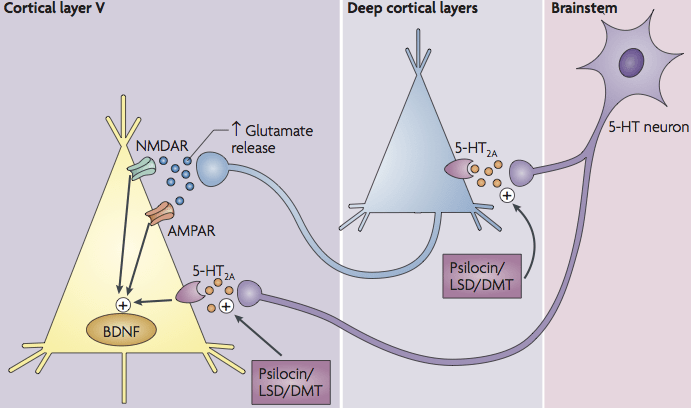
BDNF is a neurotrophin that stimulates the repair of neurons and the creation of new nerve connections. If you create more new connections than are destroyed by MS, this could in theory slow down or even reverse MS. However, there is as yet no scientific evidence that BDNF works in people with MS. A study carried out on mice with an MS-like disease found that treatment with BDNF reduced the disease and decreased inflammation and demyelination in the central nervous system. Another study in human cell cultures suggested that BDNF may have neuroprotective effects against the inflammatory response seen in MS. It therefore strongly appears that BDNF plays a role in MS.
How often should you then do a psilocybin session?
For people without MS, a guideline applies of no more frequently than one higher-dosed session every one to two months. For people with MS, a minimum interval of two weeks is maintained, with a preferred interval of two to ten weeks. Doing sessions too close together increases the risk of tolerance.
Other ways to increase BDNF
Besides psilocybin, DMT and LSD, there are also non-psychedelic ways to increase BDNF, although their effect is usually smaller. The best approach is to get as many of these factors right at the same time as possible.
Research is also being conducted into TrkB agonist peptide (developed by the Japanese company PeptiGrowth), an experimental substance that can increase BDNF without psychedelic effects. In theory, this could be a non-psychedelic alternative, although the psychedelic experience itself may also contribute to the change in mood.
Guidance during a psilocybin session
Would you like guidance with a higher-dose psilocybin sessionPlease complete our intake form first. This screens for health and safety, and forms the basis for advice on the best substance, dosage and preparation for the session.