
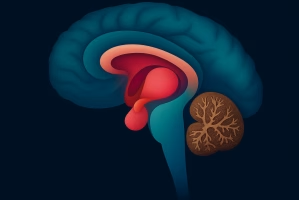
Psilocybin and the brain
When psilocybin from truffles or mushrooms is converted into psilocin in the body, a remarkable journey through the brain begins. This active molecule binds primarily to the 5-HT₂A receptors, which are present in high concentrations in various brain regions. The result is a chain of changes in perception, emotion and consciousness, which together explain the intensity and depth of a psychedelic experience. To understand why a psilocybin session can have such a powerful effect, it is valuable to look at how psilocin exerts its influence per brain region. In this blog, we take you step by step through the most important links in the brain. We go from the neocortex to the amygdala and from the hippocampus to the vagus nerve. Discover how their collaboration makes the unique experience of a truffle journey possible.
neocortex
Standard roll
The neocortex, especially the associative areas in the frontal and parietal cortex, is where abstract thinking, self-awareness, planning and meaning-making take place. Within the default mode network (DMN) form the medial prefrontal cortex and the posterior cingulate cortex nodes that direct your self-image, reflection and inner dialogue. At rest, this network predominates, whereas it is suppressed during external tasks.
receptor density
The neocortex contains the highest concentration of 5-HT₂A receptors, especially in layers III and V of the pyramidal cells. These cells are crucial for long-distance communication between brain regions. It is precisely this distribution that explains why psychedelics have such a powerful effect on perception and cognition.
Effects of psilocin
When psilocin binds to the 5-HT₂A receptors, it increases the excitability of the pyramidal cells. The result is a desynchronisation of brain rhythmsalpha and beta waves (which normally bring stability and predictability to your cognition) decrease, and a state emerges in which networks function less strictly defined. The DMN loses its dominant control, allowing “rigid priors” (fixed assumptions and thought patterns) to become looser. Subjectively, this can feel like “ego dissolution”, a feeling that boundaries between yourself and the world are blurring.
Side effects
Because the neocortex loses its tight grip, other brain regions gain more influence. Sensory input comes through more strongly, emotions from the limbic system feel more intense, and old memories are more easily re-integrated. Post-acutely, you see that this temporary flexibility is converted into structural plasticity: studies show that dendritic spines in the frontal cortex are larger and more numerous up to weeks after psilocybin, indicating lasting changes in connectivity and learnability.
Anterior Cingulate Gyrus
Standard roll
The anterior cingulate gyrus (ACC) is a crucial link between emotion and cognition. It monitors errors and conflicts, shifts attention to relevant stimuli, and regulates pain and emotional load. The ACC is part of the salience network, which decides which stimuli are important enough to focus your attention on.
receptor density
The ACC is one of the cortical areas with many 5-HT₂A receptors, which makes it susceptible to psychedelic influence.
Effects of psilocin
Under the influence of psilocin, the ACC becomes less strict in passing on salience information. This means that not only threats or important external tasks are given priority, but subtle, often ignored signals (interoceptive, emotional or spiritual) can also break through into consciousness. This can lead to a feeling that you are experiencing your emotions more “honestly” or more intensely. At the same time, the flexibility in cognitive control increases, which means people often experience during a session that they are more open to new perspectives.
Side effects
Because the ACC exerts its influence on both the amygdala (fear/emotion) and the prefrontal cortex (logical thinking), psilocin can integrate emotions and cognition in a novel way. This explains why people often emerge from a session with greater self-compassion or empathy: the rational and the emotional are no longer seen as opposing forces, but as complementary sources of wisdom.
caudate nucleus
Standard roll
The caudate nucleus is part of the striatum and is heavily involved in habitual behaviour, decision-making and loops of recurring thoughts. In collaboration with the thalamus and cortex, it forms cortico-striatal-thalamo-cortical (CSTC) loops that maintain both motor and cognitive habits.
receptor density
Fewer 5-HT₂A receptors are present here than in the cortex, though still in relevant amounts 5-HT₂C en dopaminergic modulation which are indirectly influenced via serotonergic systems.
Effects of psilocin
Psychedelics loosen the CSTC loops. This means that fixed patterns – for example, rumination or obsessive thought loops – are temporarily interrupted. Functional research with LSD (which is very similar to psilocin) shows that the feedback dynamics between thalamus, striatum and cortex changes, which is subjectively experienced as space or flexibility in thought and action.
Side effects
This relaxation allows new behavioural strategies or insights to permeate. This explains why psychedelics have therapeutic potential in obsessive-compulsive disorders and addiction: the system that rigidly repeats normal behaviour and thoughts temporarily becomes less dominant, allowing you to tread new paths.
Hypothalamus
Standard roll
Via the input of the cortex and limbic structures (especially the amygdala and hippocampus), psilocin indirectly influences the hypothalamus. As a result, physical sensations during a session may change: you can feel warmer or colder, less or more thirsty, or notice a shift in sexual energy.
receptor density
The hypothalamus has serotonergic innervation with, amongst others,. 5-HT₁A en 5-HT₂A-receptors, although the density is lower than in the cortex.
Effects of psilocin
Via input from the cortex and limbic structures (especially the amygdala and hippocampus), psilocin indirectly affects the hypothalamus. As a result, physical sensations during a session can change: you may feel warmer or colder, more or less thirsty, or notice a shift in sexual energy.
Side effects
Because the hypothalamus affects hormonal systems, psilocin can also the HPA axis modulate. This can lead to feelings of relaxation and connectedness, as cortisol responses are dampened and oxytocin/serotonin systems become more active. This explains the deep physical rest and safety that many users experience.
Amygdala
Standard roll
The amygdala forms the emotional centre of the brain and plays a crucial role in perceiving threat, regulating fear responses and linking emotions to memories. Through this function, the amygdala largely determines how intensely we experience events and how emotional experiences are stored in our memory.
receptor density
The amygdala has both 5-HT₁A as 5-HT₂A-receptors that modulate its reactivity.
Effects of psilocin
During the acute trip, amygdala activity often decreases, especially in response to emotionally negative stimuli. In healthy participants, this leads to a more positive mood. In patients with depression, it has been observed that in the days following the session, the amygdala actually more emotionally responsive becomes. This is not in the sense of fear, but in the sense of openness to allow emotions.
Side effects
This two-phase effect makes therapy more powerful: during the session, anxiety is dampened, allowing you to dare to touch upon difficult themes. After the session, emotional responsiveness is restored, so that new insights are not suppressed but actually fully experienced.
Hippocampus
Standard roll
The hippocampus is the memory centre of the brain and is responsible for recording new memories and placing them in the right context. In doing so, it gives events meaning by linking them to emotions, in close collaboration with the amygdala. At the same time, the hippocampus maintains intensive contact with the cortex, where memories are eventually stored in the long term. In this way, the hippocampus forms a link between experience in the moment and the lasting stories that determine our self-image and our life history.
receptor density
The hippocampus is rich in 5-HT1A receptor and also contains 5-HT₂A, albeit in lower concentrations than the cortex.
Effects of psilocin
Under the influence of psilocin, memories can be recalled and placed within a new emotional framework. This is accompanied by rapid neuroplastic changesdendritic spine growth, increased BDNF expression and activation of the mTOR/TrkB pathway.
Side effects
The result is that old memories do not disappear, but their charge can change. Traumas can be re-experienced with greater gentleness, allowing the brain to create a new narrative around the same facts – a crucial step in psychotherapeutic recovery.
Thalamus
Standard roll
The thalamus acts as a central relay station in the brain and determines which stimuli from the senses are passed on to the cortex. It filters sound, images, touches and internal signals so that only the most relevant information reaches our consciousness. The thalamus therefore plays a key role in attention and perception: it regulates whether we ignore a soft background noise or suddenly look up at an unexpected sound. As a gatekeeper between the outside world and conscious thought, the thalamus thus largely determines how we experience reality.
receptor density
The thalamus has serotonergic receptors, but fewer than the cortex. Yet, due to its central position, it plays a massive role in the effects of psilocin.
Effects of psilocin
Psilocin disrupts the thalamic filter function, allowing more and more intense stimuli to reach the cortex. This explains why sound, colour and touch are experienced more intensely. It can also cause hallucinations, as irrelevant or internal signals enter conscious awareness unfiltered.
Side effects
The increased permeability of the thalamus enhances the sensory richness of a trip and contributes to synaesthesia (when senses blend). This abundance of input feeds the neocortex, which attempts to integrate it meaningfully.
Corpus callosum
Standard roll
The corpus callosum is a thick bundle of nerve fibres that connects the left and right cerebral hemispheres. Thanks to this structure, the hemispheres can continuously exchange information and complement each other's functions. The left hemisphere, which is often more heavily involved in language and analytical thinking, is thus coordinated with the right hemisphere, which is instead more specialised in creativity, intuition and holistic perception. The corpus callosum therefore ensures that reason and emotion, logic and imagination, do not function in isolation, but are woven together cohesively into a seamless whole.
receptor density
Although the fibres themselves do not contain receptors, the connected cortical regions are rich in 5-HT₂A.
Effects of psilocin
Under psilocin, interhemispheric communication increases. People experience this as a fusion of reason and feeling, or as images directly connected to language and meaning.
Side effects
This increased integration gives rise to creative insights that make both logical and emotional sense – a rare synergy often experienced as a “revelation”.
Cerebellum
Standard roll
The cerebellum, also known as the little brain, is traditionally known as the centre that precisely coordinates movement and timing. It ensures that our actions unfold smoothly and precisely, from walking and writing to making music. Alongside this motor role, however, the cerebellum also appears to be involved in emotional regulation and cognitive predictions: it helps to estimate what is going to happen and thus contributes to responding smoothly to the environment. This means the cerebellum is not merely a motor organ, but a sophisticated regulator that brings body, emotion and thought into balance.
receptor density
Serotonergic receptors are present, but the density is lower than in the associative cortex.
Effects of psilocin
The cerebellum shows that movements can be experienced more smoothly and breathing more consciously. The subjective experience of time also changes because the internal clock is influenced.
Side effects
Through the connection with sensory and frontal networks, the cerebellum enhances physical harmony during a trip. This makes dance, breathing or meditation feel extra connected and meaningful.
Brainstem and raphe
Standard roll
The raphe nuclei in the brainstem form the main source of serotonin in the brain. Widely branched serotonergic projections are sent from these nuclei to virtually all brain regions, meaning they play a central role in mood, sleep, pain perception and emotional regulation. The brainstem itself also regulates fundamental bodily functions such as respiration, heart rate and the level of wakefulness or arousal. Together, the raphe nuclei and surrounding structures ensure that our brain can function in a stable physiological and emotional state, as a foundation upon which higher cognitive and emotional processes build.
receptor density
The raphe contains 5-HT1A autoreceptors, which regulate their own firing rate.
Effects of psilocin
Psilocin activates these autoreceptors, causing the natural release of serotonin to drop temporarily. At the same time, it activates 5-HT₂A receptors elsewhere, leading to a brain-wide change in signal transmission.
Side effects
This explains why psilocin is not simply a “serotonin boost”, but a complete reconfiguration of serotonergic balance. Through connections with the nucleus tractus solitarius, this also influences the autonomic nervous system, which translates to altered heart rate, breathing, and feelings of relaxation or surrender.
Vagus nerve
Standard roll
The vagus nerve is the tenth cranial nerve and forms an essential connection between the brain and the body. It sends signals from organs such as the heart, lungs and intestines to the brain and vice versa. The ventral branch normally promotes social engagement, calm and safety, whereas the dorsal branch plays a role in immobilisation and energy conservation, for example during extreme stress or deep relaxation.
receptor density
There are few serotonergic receptors located within the vagus nerve itself. Yet, this nerve has a strong connection with brain regions that are rich in 5-HT₂A receptors, such as the insula, the anterior cingulate cortex and the prefrontal cortex. Via these brain regions, vagal activity can be influenced indirectly. This explains why serotonergic substances such as psilocin have a perceptible effect on the autonomic functions that the vagus nerve controls.
Effects of psilocin
Psilocin primarily activates the 5-HT₂A receptors, altering communication patterns in brain regions associated with the vagus nerve. As a result, the ventral vagus becomes more active, leading to feelings of warmth, love, connectedness and safety. At higher doses, the balance can shift and the dorsal vagus becomes more involved, which can lead to a state of surrender and immobilisation. Many people experience this as a form of “ego death”, in which the boundaries of the self temporarily dissolve.
Side effects
The first step is the enhanced serotonergic activity in brain regions that regulate the vagus nerve. This translates to increased ventral vagal activity and a physiological state of safety. From there, a cascade of effects follows: relaxation of heart rate and respiration, a greater sense of connection with others, and a deep physical feeling of calm. At higher doses, a shift towards dorsal vagal dominance occurs, which can manifest as physical surrender or a trance-like state. This combination of phases explains why psilocin can evoke both loving connection and transcendent letting go.
Conclusion
The journey that psilocin triggers in the brain is not limited to a single region, but rather arises from the collaboration of many areas. By loosening the neocortex from its rigid patterns, causing the amygdala to react with less anxiety, placing old memories in a new light in the hippocampus, and having the vagus nerve enhance feelings of connectedness, a unique state of consciousness is created. This temporary reconfiguration of the brain opens the door to greater flexibility in thinking and feeling, and can lead to deep insights, emotional processing and lasting neuroplastic changes. That explains why psilocybin not only evokes a remarkable experience, but also has such great therapeutic potential for personal growth and recovery.
Anyone wishing to learn more about how these changes are subjectively experienced can read further in our article on the truffle journey. For a deeper dive into the effects of psilocybin and psilocin at the cellular level, we refer you to the article Psychotherapy is often unnecessary in psychedelic therapy. In this way, you gain insight into both the inner experience and the biological basis of these remarkable substances.
Experience it yourself with guidance
At Triptherapie you can experience the effects of psilocybin and psilocin in a safe and meaningful way under the guidance of an experienced therapist or tripsitter. There are two steps you need to take to make an appointment. The first step is to fill in the intake form, so that we can clearly map out your health, intentions, and wishes. The second step is to choose and book the session that suits you best, after which we will shape the rest of the journey together.