
Neurodegenerative disorders and BDNF
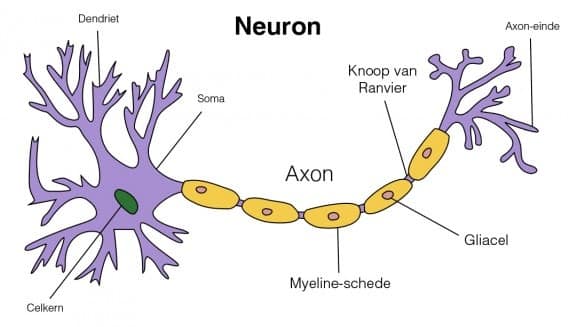
Alzheimer's, Parkinson's, and Huntington's disease are neurodegenerative disorders, or in other words, the associated symptoms of these diseases are the deterioration of neurons in the brain. A reduced level of BDNF is often measured in these patients. BDNF is a neurotrophin that enables the production of new brain cells and also promotes their regeneration. BDNF stands for Brain-Derived Neurotrophic Factor. Neurotrophins are therefore important for the survival, repair, and growth of neurons. Neurons are nerve cells that process, transmit, or process information in the brain or nervous system. Neurons can be thought of as the data cables between parts of the brain and the body. An average human body has approximately 100,000,000,000 neurons (100 billion).
Too little BDNF
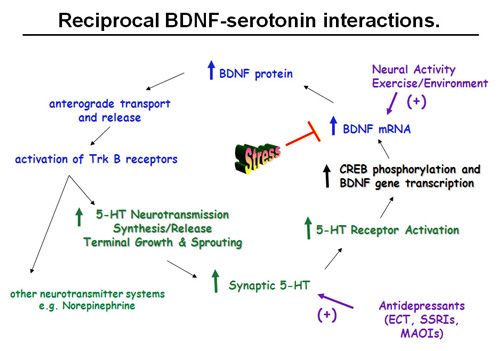
A deficiency of neurotrophins like BDNF contributes to the development of neurodegenerative disorders. A lack of BDNF prevents neurons from repairing damage. This can lead to the development of Alzheimer's, Parkinson's, and/or Huntington's disease. Furthermore, depression can develop when there is too little BDNF for a prolonged period. The degeneration of neurons in the frontal lobe appears to be the culprit. Low serotonin levels also contribute to depression. Depression is exacerbated because low serotonin levels prevent sufficient BDNF release via the 5-HT2A receptor (see the image below, and note that the 5-HT receptor is stimulated little or not at all).
More BDNF
Producing more BDNF can be achieved by stimulating the 5HT2a receptor. When the body releases more BDNF, it flips a switch on a series of genes that grow brand-new brain cells and nerve cell connections. Even slightly higher BDNF levels help you learn faster, remember better, age more slowly, and quickly rearrange your brain's connections with different parts of the brain and body.
BDNF also increases your brain's plasticity. When your brain cells are damaged or encounter a stressful situation, BDNF protects them and helps them bounce back stronger. The neural pathways become more flexible instead of broken down, which could explain why higher BDNF levels are associated with fighting off depression. Furthermore, increasing BDNF could potentially reduce the risk of diseases like Parkinson's, Alzheimer's, and Huntington's.
Psilocybin and LSD against Alzheimer's, Parkinson's and Huntington's disease
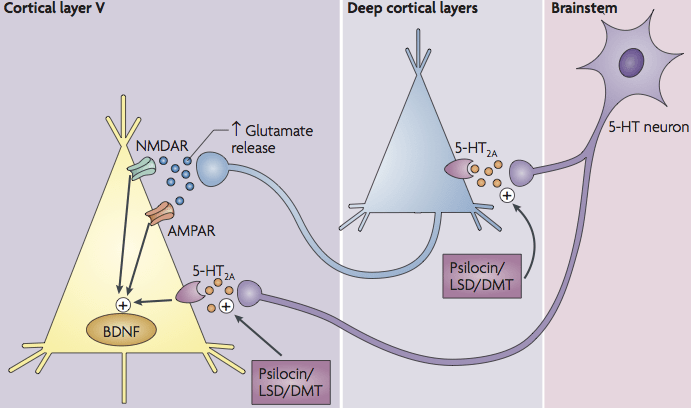
The highest possible stimulation of the 5HT2a receptor can be achieved with high doses of the psychedelics psilocybin and LSD. Psychedelics increase BDNF production and neurogenesis via the 5HT2a receptor. This explains the recent surge in research on psychedelic-assisted therapy for depression and PTSD. We also expect more research into neurodegenerative disorders in the near future, including MS.
Read more about the current research on psilocybin
Want to try a psychedelic session against neurodegenerative diseases now?
We've been offering psychedelic sessions for years, specifically for treating depression. Occasionally, clients with neurodegenerative disorders also come to us for a guided session due to the encouraging reports. Besides increasing BDNF, we also use the session to release any blockages in the subconscious. This can help us reduce stress, which in turn has a positive impact on long-term health. However, people with neurodegenerative disorders sometimes use medications that are incompatible or even dangerous when combined with psychedelics. We verify the compatibility of the medications used using an intake form. Interested? Complete the intake form or contact us.