
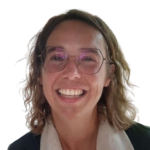
Elke can facilitate psychedelic sessions in Dutch, English and French. In addition, Elke is very strong in terms of psychological education and psychedelic guidance.
About Elke
My own path has never been very straightforward. Perhaps because I've never really fitted inside the lines myself.
From an early age, I often looked at and felt things just a little differently. I was curious about what was happening beneath the surface, sometimes sensed what was not yet being voiced, and asked questions in places where it would have been easier to walk around them. That being-different has not always been easy. It brought me a long yet fascinating quest for my own place, taking up my space in my own way and towards trust in what I feel and perceive, and finally also towards the freedom to no longer make this uniqueness smaller, but to truly inhabit it.
That search took me through various worlds, including psychotherapy, philosophy and positive psychology, but equally meditation, nature, energy work, tantra, ritual, mystical experiences and shamanic ceremonies. To me, those are not separate worlds. They continually meet around the same question: what helps a person to be truly present with themselves, with the other and with what life is asking of him or her at this moment?
I like travelling alone, precisely because it creates space to follow my intuition, to hear my own voice in the silence, and to remain completely open to what presents itself along the way. To unexpected encounters, to synchronicities, to places I didn't know beforehand that I needed. A sense of wonder is perhaps a central theme in my life: the experience that not everything can be planned or understood, and that something sometimes becomes visible when we are attentive enough to notice it.
Nature is also such a place for me. A place where nothing needs to be explained or proven and where I can experience a very direct and timeless form of connectedness. Silence does not feel empty there. It is full-bodied.
At a young age, the death of my grandmother already brought me close to grief and to existential questions for which there is no simple answer. Meditation became one of the ways in which I learned to remain present with such experiences. Not to make sadness or not-knowing go away, but to discover that even that can be borne. Perhaps part of the origins of how I work as a therapist today lies there.
Some things in life do not immediately ask for a solution. Sometimes they first ask for a place where they are allowed to just fully exist. Not everything that hurts, confuses or gets stuck needs to be immediately fixed for me or fitted into a diagnosis. Sometimes we simply find ourselves in a place where old answers no longer fit and new ones are not yet visible.
As an integrative psychotherapist, I therefore feel deeply connected to existential thought. I am interested in symptoms and patterns, but at least equally in the person who bears them and how all these questions are part of human existence. In questions surrounding loss and desire, identity, freedom and responsibility, connectedness and loneliness, meaning and change. And in the courage to increasingly shape a life that is truly your own.
My way of working
In therapy, I like to seek out real, deep contact. Not just the conversation about what someone is experiencing, but the encounter in which something can actually be felt.
Sometimes I dare to give words to what is palpable between us but not yet spoken. At the same time, I find it important never to place my perception above that of the other. For me, therapy is not a process in which I know where someone needs to go, but a joint exploration in which we remain curious about what presents itself.
I love the places where language pauses for a moment. Of silence in which something can sink in. Of music or sound that touches something for which no words yet exist. Of ritual when a transition not only wants to be understood, but also felt.
I try to hold the space and continuously retune to what is needed at that moment. Sometimes that requires conversation and reflection. Sometimes body-oriented attention, breath, meditation, music, sound or an instrument. Sometimes energetic work or ritual. And sometimes it requires nothing extra at all, other than someone who truly remains present.
My experiences with meditation, classical and neo-tantra, energetic work, ritual, the mystical and shamanic ceremonies serve as sources of inspiration within this. They are not beliefs that anyone needs to share. Above all, they help me to be able to listen in multiple languages: to thoughts and emotions, but also to the body, images, symbolism, energy, silence and relational experience.
And for me, there can be lightness in that too. I love depth, but not the idea that depth necessarily has to be heavy. Humour, warmth, playfulness and self-deprecating wit can sometimes create just enough space to get something moving again.
Psychedelic therapy
My interest in altered states of consciousness arose during my philosophy studies. Much later, that interest became very concrete again, partly through my own experiences with psychedelics and plant medicines, my participation in shamanic ceremonies and my work as a ceremonial assistant. Since 2025, I have been guiding psychedelic-assisted therapy with psilocybin myself.
My personal experiences with altered states of consciousness have not so much taught me what a psychedelic experience should be, but rather how many forms such a process can take. Above all, they have taught me humility.
An experience can be clear and insightful, but equally raw, physical, mysterious, playful, relational, spiritual or wordless. Sometimes meaning arises immediately. Sometimes only days, weeks, months or years later. And sometimes not everything needs to be understood and the experience finds its own way in our system, as something we carry with us and remember enduringly.
Therefore, I do not see psilocybin as a solution in itself, but as a potential gateway to layers of experience that are less easily accessible in ordinary consciousness. The defence mechanisms and other twists of the ‘mind’ are given less free rein, and unconscious layers get the chance to reveal themselves. That is why the quality and safety of the surrounding container are at least as important to me: preparation, safe attunement, trust, and integration.
Time and again the question is: what does this moment require? Proximity or space? A word or silence? Sound, breath, movement or simply nothing? Sometimes, staying attentively present is the most essential thing I can do.
For me, facilitation concretely means: first arriving together in the space, discussing the question and intention for this journey, seeing how we can settle into peace and relaxation and doing what is needed for that. As soon as you feel ready to go deep, I offer you the psilocybin truffles, in several portions so that you can tune in at various moments and decide whether you want to go deeper still. This within a safe container in which I am present the entire time and can offer support wherever you need it.
At the end of the journey, we take the time to return to the here and now, to reflect and to discuss what needs a little attention and/or care. Sometime later, we can meet online again for the integration into your daily life: what has this journey meant, how do you integrate this experience, and what do you still need to deal with it?
In relationships, across all gender identities and neurodivergence
Alongside individual therapy and a special affinity for neurodivergence and LGBTQIA+, relational work is very close to my heart. Drawing on my experience as a relationship therapist, I look forward to also guiding couples, polycules and other duos within psychedelic journeys, for example a parent and adult child, or friends and siblings.
Relationships are special places of encounter. There, our desires, vulnerabilities, defence mechanisms and ways of loving often become very visible. We can find each other there and lose each other. Precisely for this reason, it can be valuable not only to look at the two individuals, but also at what lives between them.
A shared psychedelic experience can open up new layers within that. For me, that calls for extra care: space for everyone's individual experience and for the relationship itself, without predetermining what should change between two people.
Ultimately, that is perhaps what interests me most: truly meeting. Beyond roles and diagnoses. Beyond the versions of ourselves we have learned to show in order to belong. Closer to that which still lives beneath. I would almost call it a meeting from essence to essence.
My role in that is not to map out the way for someone. Rather, to walk alongside them for a bit, to look attentively, sometimes to ask a question that we might otherwise continue to walk around, and to hold space for what does not yet have a name.
Because sometimes change doesn't start with searching harder. Sometimes it starts when we trust ourselves enough to listen to what has been there for a long time.
Professional background
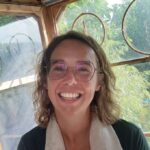
My therapeutic foundation is integrative and broad. Alongside years of experience as a psychotherapist, I have worked as a lecturer and supervisor within training programmes for applied psychology, orthopedagogical guidance and integrative psychotherapeutic counselling. There, I taught subjects including psychology, trauma-informed counselling, family systems, positive psychology, health psychology, psychotherapeutic techniques and professional practice.
A selection of training courses and specialisations that have strongly shaped my current way of working:
Integrative Psychotherapy — Academy for Integrative and Humanistic Psychology and Psychotherapy (AIHP)
Specialisation in Guidance in Existential Wellbeing — KU Leuven
Bachelor of Applied (Clinical) Psychology — Lessius University College Antwerp, with high distinction
Philosophy — Ghent University
Zendo SIT – Sitting and Integration Training, specialised training in psychedelic care
Focusing, level 1–4
ACT – Live life to the full, train-the-trainer
Narrative therapy
Sandplay therapy
Solution-focused brief therapy
In-depth study of nervous system regulation and trauma-informed working via Deb Dana
Specialisation in Internal Family Systems (IFS) and Compassionate Inquiry, including via Richard Schwartz and Gabor Maté
Experience with mindfulness, meditation, breathwork, tantric and conscious bodywork, energy work and spaceholding
Active as a ceremonial assistant at shamanic ceremonies since 2024
Master of Science in Psychology (Vrije Universiteit Brussel) and years of work experience as a lecturer/supervisor at Thomas More University of Applied Sciences further complement this profile.
Reviews about Elke
Elke is valued by her clients for her warm involvement, open attitude and professionalism. To get a better idea of Elke, we recommend that you read the reviews about Elke.
I feel privileged to be allowed to walk a short stretch alongside you on such a personal and meaningful journey. I look forward to meeting you and, together, with confidence, attentiveness and wonder, making space for whatever may present itself along the way.
Elke van den Neucker
Contact Elke
Would you like to connect first before booking a session with me? That is completely understandable! You can get in touch with me using one of the options below. For phone contact, if there is no answer, it is best to send me a message via WhatsApp, Telegram or email.
Book a psychedelic session with Elke
I work in a large area of the Netherlands. I am from Westdorpe myself (in the southern tip of Zeeland, the Netherlands). Because of my maximum travel time of 3 hours, I mainly work in the southern provinces of Zeeland, North Brabant and Limburg. I also travel slightly further to South Holland, Utrecht, Gelderland, North Holland and Overijssel. You can calculate my work area and travel allowance using the calculation tool.