
New research into psilocybin from 2023
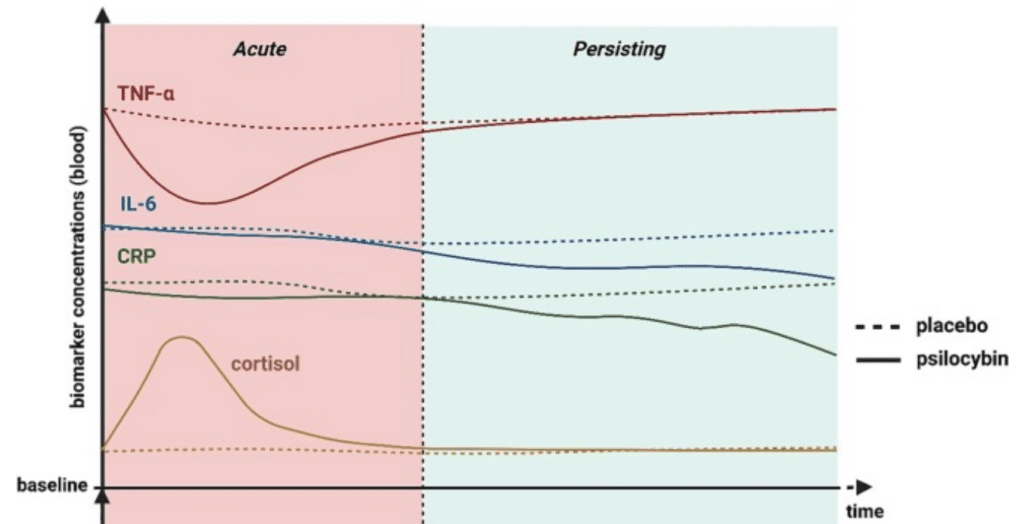
Recent research (publication date 7 September 2023) shows that psilocybin can cause long-term improvements in the immune system of healthy individuals. Depression is increasingly seen by specialists as a consequence of inflammatory responses. Reducing inflammatory products can therefore contribute to recovery in depression and anxiety symptoms. In the recent study, a significant change in the inflammatory markers TNF-α, IL-6 and CRP was measured compared to the placebo group.
Inflammation is the body's natural response to injury or infection. However, when it persists for too long, it can cause damage. With chronically high inflammation levels, people become depressed. Depression can prompt individuals to change location and circumstances. From an evolutionary perspective, therefore, depression is an advantage because changing circumstances can lead to better health.
Scientific research has shown that there is a link between inflammatory processes in the body and depression. Several inflammatory markers have been linked to depression, including TNF-alpha, IL-6 and CRP. These are precisely the inflammatory markers that psilocybin has a beneficial effect on. We will provide more explanation for each inflammatory marker
TNF-alpha and psilocybin
TNF-alpha, fully tumour necrosis factor-alpha, is a cytokine that plays an important role in the body's inflammatory response. It is produced by various types of cells in the immune system and acts, amongst other things, as a signalling molecule to attract inflammatory cells to the site of infection. TNF-alpha can also increase the expression of other pro-inflammatory genes and thereby amplify the inflammatory response.
One of the ways in which psilocybin works is by regulating the inflammatory response in the body. The latest study has shown that psilocybin can lead to a reduction in the production of pro-inflammatory cytokines such as TNF-alpha. This may be an important mechanism for the anti-depressive and anti-anxiety effects of psilocybin, since excessive production of TNF-alpha is linked to depression and anxiety. Furthermore, psilocybin also has a direct influence on the immune cells that produce TNF-alpha. It has furthermore been shown that psilocybin can reduce the activity of these immune cells, thereby reducing the production of TNF-alpha and inhibiting the inflammatory response in the body.
CRP and psilocybin
CRP, or C-reactive protein, is a natural inflammatory marker that increases in response to inflammation and injury in the body. Elevated levels of CRP are associated with various health problems, including cardiovascular disease, arthritis and autoimmune diseases, depression and anxiety symptoms.
The new research suggests that psilocybin may have anti-inflammatory properties and could potentially lower CRP levels in the body long after the session.
IL-6 and psilocybin
IL-6 stands for Interleukin-6, which is also a cytokine, and is a protein that regulates signalling between cells. It plays an important role in the immune system and inflammatory processes in the body. IL-6 is produced by various types of cells, such as white blood cells and epithelial cells.
When the immune system is activated by, for example, bacteria, viruses, oxidation processes or foreign proteins, the production of IL-6 is increased. This helps the body to fight the infection.
However, an overproduction of IL-6 can also be harmful. This can lead to chronic inflammatory diseases such as rheumatoid arthritis or inflammatory bowel disease. In addition, there is also a link between increased IL-6 production and psychological disorders such as depression and anxiety. This is because IL-6 can cross the blood-brain barrier and thus influence brain function.
Recent research has shown that psilocybin can reduce the production of IL-6. This study demonstrated that psilocybin reduced the production of pro-inflammatory cytokines, including IL-6, even in the long term. This may potentially explain why psilocybin can be effective in treating depression, anxiety and post-traumatic stress disorder (PTSD).
The cortisol spike
Cortisol is the stress hormone that also suppresses the immune system. During the measurements of the discussed study (see image above), the amount of cortisol rises at the beginning of the session, after which it heads towards the baseline. This cortisol peak is partly due to the tension people feel before a psychedelic trip, supplemented by the necessary response to manipulate the immune system. This explains why some individuals experience the beginning of psilocybine trips as tense. As a counter-reaction, the increased activity at the serotonin receptors, particularly the 5-HT2A variant, as well as other receptors, can induce a state of contentment. As a result, the stress can dissipate.
Less glutamate in the hippocampus
The hippocampus is an important part of the brain involved in memory and emotion. Glutamate is a neurotransmitter that plays a role in this, but an excess of glutamate can lead to overstimulation of the brain cells, which is associated with anxiety and depression. This is because glutamate activates the N-methyl-D-aspartate (NMDA) receptors, which in excess can lead to neurotoxicity.
Psilocybin can help to restore this imbalance between glutamate and TNF-alpha. Psilocybin can inhibit the expression of TNF-alpha and can also modulate the activity of the NMDA receptor, thereby reducing the overstimulation of brain cells. This can lead to a reduction in anxiety and depression symptoms.
According to recent research, lowering TNF-alpha correlates with a reduced amount of glutamate in the hippocampus. In theory, psilocybin could therefore reduce glutamate via the reduction of TNF-alpha, with the benefit of inhibiting anxiety and depression. However, the correlation can also be interpreted the other way around; psilocybin reduces glutamate activity and thereby also TNF-alpha.
We previously wrote a post about glutamate in the hippocampus and how that can influence the experience of a negative event during psychedelic sessions. Read more about the role of glutamate and how GABA can help via the button.
Summary of the research
The research showed a reduction in TNF-α during the psilocybin session. Furthermore, IL-6 and CRP showed a significant decrease after seven days compared to the placebo group. The participants noticed long-lasting positive effects after psilocybin. Moreover, a greater drop in IL-6 and CRP levels after one week correlated with a better mood and social behaviour. By reducing the production of inflammatory markers, psilocybin not only potentially alleviates inflammatory responses, but also enhances feelings of connectedness and positive well-being.
Psilocybin works in multiple ways
This article only partially describes how psilocybin works. Other factors include increasing BDNF, neuroplasticity, spiritual experiences and more. Use the buttons below to learn more about the effects of psilocybin.