Private truffle ceremony or group ceremony
In this article we assume that a private truffle ceremony stands for an individual truffle session. During this, you get the full attention of the therapist or tripsitter of your choice. Are you still hesitating whether you actually want to choose an individual truffle ceremony or an open truffle ceremony? We list the benefits below. Should you actually mean a closed truffle ceremony, so a private truffle ceremony with a self-assembled group? Then make use of the button below.
Individual truffle session
The benefits of an individual ceremony include:
Privacy and intimacyThe experience can be more private and intimate, which can contribute to a deeper personal connection. During therapeutic sessions, certain individuals often feel more at ease and are able to let go more than in group sessions.
Complete personalisationThe ceremony can be fully personalised based on individual needs and goals.
- Choosing a supervisor: For individual truffle sessions, you can choose your own guide and there are more days available than for group truffle ceremonies.
- Choosing locationFor the private sessions, the client can choose where the session will take place. This can be at their home address, a rented location or at our location.
In-depth therapeutic experiencesIndividual sessions can provide profound therapeutic experiences that are less easily achieved in a group setting.
Safety and trustA private session can provide a sense of safety and trust.
FlexibilityThere is more flexibility in session length, timing, and the set and setting
Open truffle ceremony
The benefits of a truffle ceremony for groups include:
- Sense of communityThe opening ceremonies offer the opportunity to meet new like-minded people, which can create a sense of belonging.
- A sense of securityFor some, it feels safer to take part in a group ceremony than in a private session. The presence of others actually provides peace of mind.
- GuidanceThere are multiple facilitators present to ensure that the ceremony runs safely and in a structured manner. You can choose for yourself which facilitator you would like to connect with during the ceremony.
- CostGroup sessions are more cost-effective than individual therapy because the costs are shared among multiple participants.
- Sharing experiencesSharing experiences with other participants can help to better understand one's own experience and gain new insights.
- Longer programmeAt the group truffle ceremonies, the programme is longer and more is done than just the truffle ceremony, such as breathwork.
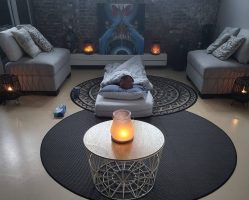
- Location: At truffle ceremonies, a location is used that is specially designed for the ceremonies, including art and objects.
How does a private truffle session work
A truffle session has multiple phases such as the intake, preparation, the session itself and the integration. The complete package makes a truffle session more effective than just the session with truffles itself. We have broken down the truffle session programme into four phases below.
Intake
If you want to book a private truffle session with us, there are a number of steps that need to be taken. First, you need to complete an intake form so that we can check for any contraindications and determine the best approach for your specific situation. After completing the intake form, you will receive personal advice regarding the session and the dosage that suits you best. You can then schedule an appointment using the links provided in the email containing the advice.
Preparation
truffle session
Integration
Choose a tripsitter or therapist
The individual truffle ceremonies offer benefits in their own unique way that might appeal to you. If you choose an individual session and are medically fit to undergo such a truffle session, the next step is important. Choosing a guide is crucial, and a sense of trust and peace that you feel with someone plays a very major role. You can choose your guide by, for example, asking yourself whether you would prefer a male or female guide and what qualifications this person has. Their level of experience may also be important to you. Therefore, take a look at the overview below to have a preliminary glance at the therapists and tripsitters who work with us. Via the LinkedIn button you can read more about the guides on LinkedIn, via the calendar button you can view availability, reviews can be read via the thumbs-up button, and the profile pages can be read by clicking on the photo or name.
With a background in chemistry, a passion for philosophy, combined with a wealth of knowledge on psychology and health, his approach is holistic. Marcel is a full-time trip guide. With more than 2,450 guided sessions, Marcel has the most experience on our team.
Psychosocial therapist
🇳🇱 🇬🇧 🇩🇪
Ronald is a psychosocial therapist and has completed the following training: Jungian Philosophical Therapist, Psychodrama Therapist, Master Voice Dialogue, Transformation Psychology, Internal Family Systems (IFS), and Mindfulness and Compassion Trainer.
Janneke studies Applied Psychology, is a lifestyle coach, handles initial client contact, draws up lifestyle plans and carries out administrative tasks. She also acts as a confidential adviser. Alongside these duties, she has limited availability for facilitating sessions.
As a psychologist, Reineke combines both conventional and alternative care methods. She uses various techniques, such as talk therapy, yoga, breathing exercises, and EMDR in combination with the therapeutic effects of psychedelics.
With her degree in psychology, Master's in Clinical Psychology, and work experience as a psychologist in addiction care, (specialised) mental healthcare, and rehabilitation, Sascha has a strong foundation as a psychedelic therapist. She has additional training in cognitive behavioural therapy and EMDR.
Integrative psychotherapist
Self-employed in the Netherlands
🇳🇱 🇬🇧 🇫🇷
With her Master’s degree in psychology, her training as an integrative psychotherapist at the AIHP, and her many years of work experience as a psychotherapist, lecturer and supervisor, Elke has a solid foundation as a psychedelic therapist. She has additional training in existential wellbeing (KU Leuven), Zendo SIT (Sitting and Integration Training) and Internal Family Systems (IFS).
Gijs has 20 years of experience in outpatient mental healthcare. He taught and provided supervision for the Mental Health Nursing (MGZ-GGZ) degree programme at HAN University of Applied Sciences. Furthermore, Gijs has broadly developed himself in mindfulness, talk therapy, neurofeedback, meditation, compassion training and ACT.
Supportive therapist
Ylva is a BIG-registered Healthcare Psychologist and supports Triptherapie as a consultant in the fields of psychological care, mental healthcare frameworks, safety and integration. Ylva does not offer psychedelic sessions, but is available for additional support.