

Magic mushrooms are dangerous!?
Magic mushrooms and truffles contain psilocybin and psilocin. These substances can strongly alter perception, emotions, thoughts and the experience of time. A psychedelic experience can be meaningful for some people, but is not without risk.
The risks are related, among other things, to the type and quantity used, the user's health, psychological vulnerability, medication, other substances, the environment, and the guidance provided. Because the composition and strength can vary, the effect is not entirely predictable.
On this page we explain which risks are important and why screening and preparation are necessary.
Magic mushrooms and truffles
Magic mushrooms usually refer to the above-ground parts of certain fungi. Magic truffles are the underground sclerotia of certain fungi. Both can contain psilocybin and psilocin, but they are not the exact same product.
The strength can vary per species, product and batch. It is therefore incorrect to say that magic mushrooms always contain a lower concentration of active substance than mushrooms.
Possible physical effects
During or after a psychedelic experience, physical effects may occur, such as:
- nausea;
- dizziness;
- increased heart rate;
- changes in blood pressure;
- perspire;
- vibrate;
- fatigue;
- headache;
- reduced coordination;
- an altered perception of pain or bodily signals.
These effects are often temporary, but can be intense. In people with cardiovascular problems, uncontrolled high blood pressure or certain neurological disorders, the risk may be greater.
Psychedelics can also pose an indirect physical danger if someone under the influence falls, enters traffic, goes into water, gets up high or has insufficient supervision. A safe environment is therefore important.
Psychological risks
A psychedelic experience can intensify emotions and thoughts. Possible reactions include:
- anxiety or panic;
- sorrow;
- confusion;
- paranoia;
- loss of control;
- disorientation;
- unpleasant memories;
- a sense of alienation;
- sleep problems or emotional aftermath.
A difficult experience is sometimes called a bad trip. Good preparation and calm guidance can reduce the likelihood of panic or unsafe behaviour, but no one can guarantee that a difficult experience will not occur.
Afterwards, some people may continue to be sensitive, fatigued or emotional for a longer period of time. When symptoms persist or increase, it is important to contact a GP or practitioner.
Psychosis susceptibility and manic dysregulation
Psychedelics can trigger or intensify psychotic or manic symptoms in vulnerable people. Extra caution is required with:
- a personal history of psychosis;
- schizophrenia or another psychotic disorder;
- a personal or familial predisposition to psychosis;
- a history of mania;
- bipolar disorder;
- severe dissociation;
- acute suicidality;
- severe psychological instability.
Participation may be discouraged in these situations. Age alone is not a reliable way to rule out psychosis risk. There is no magic age at which psychedelics become safe for everyone.
Addiction and tolerance
Psilocybin is generally not seen as a substance that causes physical dependence in the same way as, for example, alcohol, nicotine or opioids. That does not mean that every use is without risk.
People can indeed start using psychedelics problematically, for example when they constantly want to escape a difficult situation, keep chasing experiences or avoid regular help. Repeated use can also lead to disappointment, psychological exhaustion or problems in daily life.
If problematic substance use is suspected, professional help is important, although frequent use of truffles or magic mushrooms can occur very rarely due to the build-up of tolerance.
Medication and other substances
Psychedelics can interact with prescribed medication, over-the-counter medicines, supplements and recreational drugs. The risks depend on the substance, the dosage, health and the combination.
Therefore, always mention during an initial consultation:
- antidepressants;
- antipsychotics;
- ADHD medication;
- sleeping pills and sedatives;
- painkillers;
- blood pressure medication;
- migraine or cough medicine;
- supplements and herbs;
- alcohol, cannabis and other drugs.
Never stop or reduce your medication on your own in order to take part in a psychedelic session. Only the prescribing doctor can assess whether a change is safe.
Do not combine psychedelics with alcohol, stimulants or other drugs. When combined, the effects become less predictable and physical and psychological risks can increase.
Looking for magic mushrooms and the wrong mushrooms
Foraging for mushrooms yourself is risky. Poisonous species can resemble species that contain psilocybin. A mistake can lead to severe poisoning.
Do not use self-foraged mushrooms unless you have had the species identified with absolute certainty and by an expert. In the event of potential poisoning, you must seek medical help immediately.
Traffic and environmental risks
Under the influence of psilocybin, perception, judgment, coordination and perception of time can change. Therefore, do not drive a car, cycle in heavy traffic, swim, climb or work with machinery.
How mentoring can help
A support worker can provide calm, presence and practical safety. When someone becomes frightened, confused or overwhelmed, a support worker can help bring their attention back to their breathing, body and surroundings.
Guidance cannot entirely prevent a difficult experience. Nor is a guide a replacement for a doctor, psychologist or psychiatrist. However, a good guide can respond appropriately and, in an emergency, call in the right professional.
In the event of severe psychological symptoms or medical risks, participation may be discouraged. Sometimes regular care, extra preparation or integration is more appropriate.
Figures on harm
A comparison with other substances shows that truffles and magic mushrooms very rarely result in physical or psychological harm.
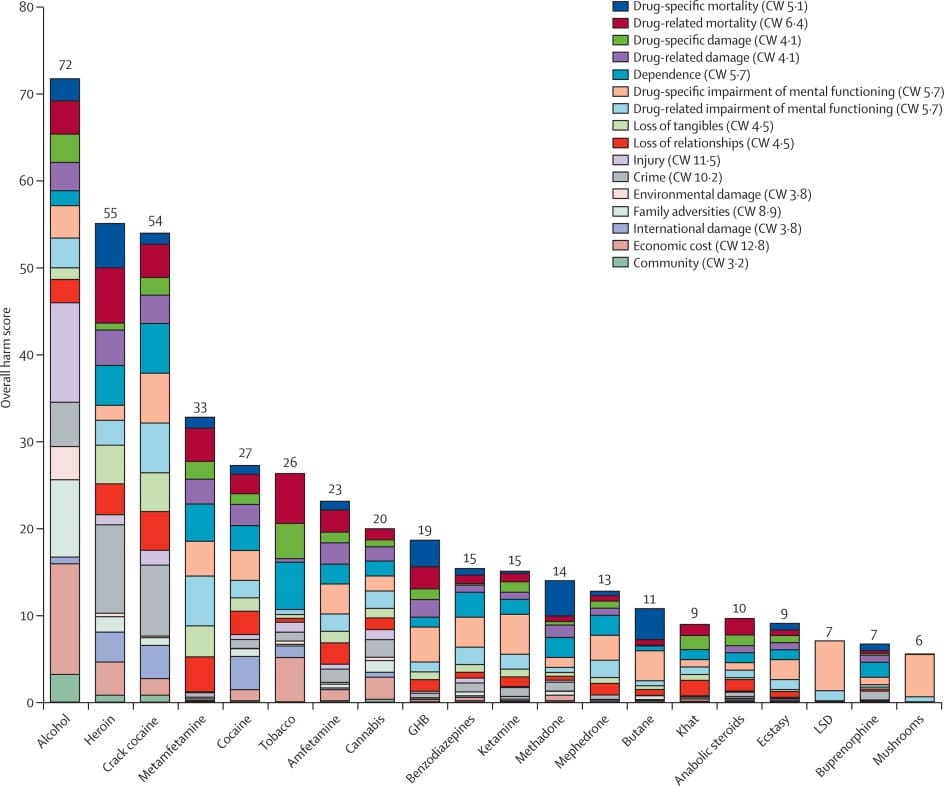
Magic mushrooms are not addictive
Magic mushrooms are not physically addictive. Tolerance also occurs, so eating more does not work. Even using a lot of magic mushrooms day after day does not work. You can only have a good trip once a week, and it is even better to wait 2 weeks. The chance of physical harm is almost non-existent. The theoretical lethal dose is 1,000 times higher than the active dose. Converted to magic mushrooms, that is 10 kg of magic mushrooms. That is what an average person would eat over 4 days combined.
The real risks
The biggest danger of magic mushrooms is global legislation. This is often proclaimed abroad. In the Netherlands, magic truffles are legal and this is less of a major issue. Furthermore, use is not punishable in the Netherlands. However, detectability by means of testing will not exceed a maximum of 48 hours. Most drug tests will not test for magic mushrooms, though. This only happens in the event of an intoxication (which is very difficult with magic mushroom use).
According to experts, these are the risks:
Addiction
The risk of addiction is low. However, rapid tolerance does occur. If you use too frequently in succession, the effects no longer occur and you have to stop for some time to feel the effects again.
NO PHYSICAL RISKS
The physical risks of psychedelic mushrooms are negligible. Permanent organ damage has not been reported anywhere to date. The toxicity of psilocybin is very low. Estimates suggest that a lethal dose of psilocybin is at least 1000 times the active dose, which is a very wide margin of safety
SUBJECT TO FREQUENT USE
The properties of magic mushrooms ensure that the drug does not lead to repeated use. This is due to:
Rapid tolerance. You quickly grow accustomed to the medication. The effects then no longer occur. You must then stop for some time for the effect to occur again.
The intense experience. Using magic mushrooms is an intense experience that can last anywhere from four to six hours. This is another reason why the substance is not frequently used. It is an experiment that most people do a number of times. After that, use stops or remains limited to the occasional time.
People who are emotionally unstable or have psychological issues have a greater chance of getting into trouble through the use of magic mushrooms. For children, psilocybin-containing mushrooms are toxic.
Mushrooms that produce tripping effects are sometimes difficult to distinguish from poisonous species. Foraging for mushrooms yourself is therefore strongly discouraged.
Magic mushrooms can trigger psychosis in individuals who are susceptible to psychoses. Furthermore, people who have experienced psychosis can suffer a relapse of their psychosis after using magic mushrooms.
So many other experts and researchers assess the risk as very low. There is only the risk of a bad trip and in a very small group of psychosis-prone individuals, a psychosis. In those individuals, with or without drugs, a psychosis would likely already emerge during the early years of their life. Magic mushrooms, truffles, weed, LSD or other drug use can trigger it earlier.
Avoiding the risks and using the positivity
Age.From the age of 23, the risk of psychosis is very small. This is because people who are sensitive to psychosis have then reached an age at which a psychosis would likely have already manifested. Under 18, we advise against use. From 21, it would already be possible.
Mental health conditions. If you have (had) psychosis, we advise against any substance use. You can only do this with proper guidance. In the case of schizophrenia, we advise against it entirely at this moment.
Medication. The use of magic mushrooms and/or truffles can be unpredictable in combination with certain medication. Medication such as antipsychotics and MAO inhibitors cannot be combined with psychedelics. With some medication, you must first taper off before you can have a trip.
Setting. The setting largely determines the effect of a trip. A pleasant atmosphere and a trip coach prevent a bad trip and ensure that you are comfortable and get the most out of the trip.
Good guidance
You can count on us for the right guidance for your situation. Everyone is different and everyone needs a different plan. We can be of service to you. For example, you can take a free intake by filling out the intake form. Would you like to learn more first? Feel free to read all the information or contact us.